
The GCC skyline tells a story of ambition. Cranes rise over Riyadh, Dubai, Doha, and Abu Dhabi like punctuation marks on a sentence the region keeps writing about growth. Yet beneath the glass towers and giga-projects, a quieter debate shapes every blueprint: should developers stick with traditional building methods, or should they embrace Energy Efficient Construction as the new standard?
This question matters more in the Gulf than almost anywhere else. Extreme heat, water scarcity, and ambitious net-zero targets push governments and developers to rethink how they build. Understanding the real difference between traditional methods and modern building approaches helps investors, architects, and homeowners make smarter decisions.
The Traditional Approach: Familiar but Flawed
Traditional construction in the GCC relies on methods that have served the region for decades. Contractors pour concrete on-site, assemble materials sequentially, and depend heavily on manual labor. Builders follow a linear process: design, procure, build, inspect, repeat. This approach delivers results, but it carries hidden costs.
Traditional projects often consume excessive water during curing, generate significant waste, and stretch timelines due to weather delays and labor bottlenecks. In a climate where daytime temperatures regularly exceed 45 degrees Celsius, outdoor labor slows dramatically during summer months. Material waste also piles up, since older methods rarely optimize for precision cutting or modular reuse.
Cost overruns frequently follow. Developers underestimate how much unpredictable weather, inconsistent labor availability, and material spoilage add to a project’s final bill. Traditional buildings also tend to consume more energy over their lifetime, since insulation, orientation, and passive cooling rarely factor into early design decisions.
None of these means traditional construction lacks value. Skilled masons and craftsmen bring cultural authenticity to heritage projects, and some traditional techniques suit specific climates and budgets. But as the GCC races toward Vision 2030, Qatar National Vision 2030, and similar national strategies, the region needs a faster, smarter path forward.
Energy Efficient Construction: A Smarter Way to Build
Energy Efficient Construction reimagines the entire building process. Instead of treating design, procurement, and assembly as separate stages, this approach integrates them from day one. Teams use Building Information Modeling (BIM) to simulate a project digitally before laying a single brick. This foresight eliminates costly design clashes and reduces material waste significantly.
Prefabrication and modular assembly define much of what makes this approach so effective. Factories manufacture wall panels, MEP systems, and structural components off-site under controlled conditions. Cranes then lift these components into place, cutting timelines by as much as 40 percent compared to traditional builds. This method also reduces dependency on unpredictable weather since factory-based production continues regardless of outdoor heat.
Labor productivity improves dramatically under this model. Workers spend less time repeating manual tasks and more time overseeing precision assembly. This shift also improves safety, since factory environments carry fewer risks than open construction sites baking under the Gulf sun.
Cost efficiency represents another major advantage. Energy Efficient Construction reduces material waste through precise digital planning and shortens project timelines, which directly reduces labor and financing costs while delivering buildings that consume significantly less energy over their lifetime. Developers who adopt this approach often report savings of 15 to 25 percent across a project’s lifecycle, a figure that becomes significant when applied to giga-projects like NEOM or Expo City Dubai.
Where Sustainable Construction Technology Fits In
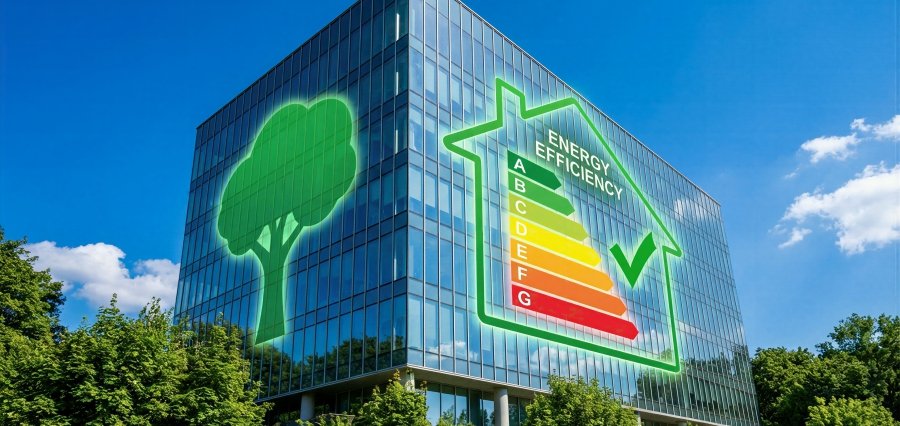
Energy Efficient Construction and Sustainable Construction Technology work hand in hand, though they address slightly different priorities. The former focuses on speed, cost, and process optimization, while the latter focuses on environmental impact, resource conservation, and long-term ecological responsibility.
Sustainable Construction Technology includes solar-integrated building materials, greywater recycling systems, low-carbon concrete alternatives, and smart HVAC systems that reduce cooling loads in extreme heat. The GCC’s push toward carbon neutrality, particularly Saudi Arabia’s Green Initiative and the UAE’s Net Zero 2050 strategy, relies heavily on this technology to meet ambitious emissions targets.
Developers increasingly combine energy-efficient building methods with Sustainable Construction Technology to create buildings that go up faster and consume fewer resources once occupied. A modular building assembled through this approach, for example, can incorporate passive solar shading, recycled steel framing, and high-performance glazing that reflects heat rather than absorbing it.
This combination matters because speed alone does not solve the GCC’s environmental challenges. A building erected quickly but poorly insulated still drains energy resources for decades. Sustainable Construction Technology ensures that the buildings produced perform well over their operational lifespan, not just during the ribbon-cutting ceremony.
Government mandates increasingly require this pairing. Dubai’s Green Building Regulations and Abu Dhabi’s Estidama Pearl Rating System now push developers to integrate sustainable, resource-conscious systems into every new project. This approach gives developers the tools to meet these mandates without blowing through budgets or missing deadlines.
The Real-World Impact Across the GCC
Major developers across Saudi Arabia, the UAE, Qatar, and Bahrain now favor Energy Efficient Construction for large-scale residential, commercial, and infrastructure projects. NEOM’s modular housing units demonstrate how this approach can produce thousands of livable units in a fraction of the time traditional methods would require. Dubai’s affordable housing initiatives similarly lean on faster building methods to meet population growth demands without sacrificing quality.
Hospitals, schools, and transit infrastructure also benefit. Energy-efficient construction helps governments deliver public infrastructure faster while meeting the environmental standards set by national visions and sustainability mandates. When this technology gets built into these projects from the start, the resulting buildings consume less energy, require less maintenance, and align with national environmental commitments.
Private developers notice the financial upside too. Energy Efficient Construction reduces the risk of cost overruns and delivers buildings that perform better over their lifetime, lowering utility costs and strengthening ESG credentials. Investors increasingly favor projects that showcase both, since these buildings attract tenants who prioritize performance and responsibility alike.
Making the Right Choice
Choosing between traditional methods and the efficient approach is not always black and white. Heritage projects, small-scale renovations, and culturally significant builds still benefit from traditional craftsmanship. But for large-scale developments, commercial real estate, and any project operating under the GCC’s ambitious timelines, Energy Efficient Construction offers clear advantages.
The smartest developers do not choose one approach and abandon the other entirely. They blend speed and precision with the environmental benefits of Sustainable Construction Technology, creating buildings that rise quickly and perform efficiently for decades. This blended approach positions the GCC to meet its Vision 2030 goals while building a legacy that future generations can rely on.