

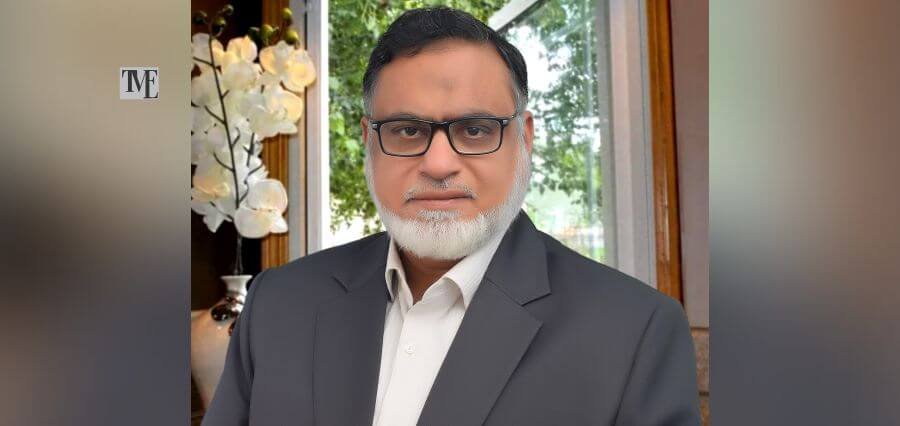
The finance industry in Saudi Arabia is experiencing a revolution that it never had before. With the breathtaking aims of Vision 2030 in its lead, the Kingdom is not only modernizing its economic paradigm, but it is authoring a new one. And the rulers who come to that time are not representatives of an old order. They are its builders.
Several jobs in the finance field are characterized by a major deal, a perfectly timed bet or a product that transformed a market. But Abdul Khaliq Ahmed’s journey was built on one main question: what creates the growth built to last?
It is a simple question with false pretence. And by seeking its answer, he has come to something much more decisive than a plan. He has come to a philosophy. He is leading the charge and bringing together his investment banking skill set, strategic discipline and deep understanding of emerging fintech play platform into the formula for long-term sustainable growth in this fast-paced industry.
In his latest role as Chief Growth Officer at Tabashir Arabia, a privately-owned credit and trade finance company founded in 2024. He has a clear focus in line with the requirements of Vision 2030 in the need to have a diversified and sustainable Saudi economy; he tasked himself with something that goes far beyond capital allocation.
His business principles are based upon three intersecting values, including repeatable value creation, responsible finance, and platform thinking. Collectively, they constitute what he feels is the cultural infrastructure of the new generation of Saudi finance.
The approach of sustaining growth for him came while he was responsible for developing the introduction of a proprietary investment strategy across multiple asset classes for a cumulative market capitalisation of over SAR 23 billion.
He is a leader who believes that the most effective way to grow is to create a systematic infrastructure of trust, which will ultimately create growth for everyone else around them. That type of thinking will probably be precisely what the time demands in a kingdom rewriting its economic future in real time.
The Moment it Clicked
In the world of international finances, few journeys are as transformative as Abdul Khaliq’s. His path was defined early on by landmark transactions that taught him the true meaning of collaboration across borders.
Every leader has a formative experience, a moment when theory meets reality hard enough to change how they think permanently. Ask him about the origin of his growth philosophy, and he will take you back to an investment banking assignment that transformed his view on how scale operates.
Designing the Blueprint for Growth
The first several years of his experience in investment banking and asset management set him up well for identifying patterns across all industries, so when the opportunity to become Tabashir’s CGO came along, he did not view the move as a lateral opportunity; he viewed it as an organic evolution from “funding the growth” to “architecture of growth.”
He was leading the expansion of a proprietary investment strategy across multiple asset types with a total market cap above SAR 23 B. “While sourcing capital wasn’t a problem, my greatest challenge was successfully aligning product design with risk management, market relevancy and execution capability all at once,” said Ahmed.
This experience taught him a lesson that most professionals spend years learning: You need more than just capital to drive long-term sustainable growth. Capital is a resource. It is necessary, but it is not sufficient. What transforms capital into sustainable growth is the system around it.
As a result, he began to think of growth as a systems discipline, a methodical approach to developing and testing a framework that an organization must develop, refine and integrate into their operations instead of “winging it.”
Growth With Discipline
As of 2026, Abdul Khaliq redefined growth at Tabashir by employing a strategy of ‘repeatable value creation’. This strategy emphasises not just fast growth, but growth that can be replicated, and expansion that contributes to strengthening the platform rather than stressing it.
In practice, this means holding multiple priorities simultaneously, like considering increasing revenue, improving unit economics, expanding user base, decreasing risk concentration, and expanding market reach, while also maintaining governance and core values, all of which contribute to true progress.
“For a Saudi-focused platform like Tabashir, sustainable growth also means relevance: solving real problems for SMEs, traders, and supply-chain participants in ways that align with local market behaviour. Growth is successful only if it compounds trust,” he states
This approach makes it clear that in Saudi Arabia’s evolving digital economy, durability beats speed. By prioritising problem-solving relevance and consistent user experience, the platform positions itself not merely as a marketplace but as a dependable infrastructure for its stakeholders. In the long run, trust is not a by-product of growth; it is the engine that makes growth sustainable.
Building on Vision 2030
Saudi Arabia’s Vision 2030 is the backdrop against which Tabashir plots its strategy. Abdul Khaliq reads the Kingdom’s reform agenda not as an external regulatory framework but as a business opportunity hiding in plain sight.
Vision 2030 sets ambitious targets around SME empowerment, private-sector expansion, and financial inclusion. He believes the company’s private credit and trade-finance solutions directly address the most persistent structural challenge, which is connecting small and mid-sized businesses to responsible, friction-reduced financing. These are not abstract aspirations. They describe real structural gaps in the Saudi market.
For him, staying ahead of the curve is not a passive act but an active process. By doing so, the organisation participates in economic diversification, job creation, and non-oil GDP growth, three pillars the Kingdom has identified as central to its transformation. “Our platform approach ensures that growth is not extractive but catalytic, strengthening supply chains, improving liquidity cycles, and supporting entrepreneurship at scale,” he explains.
This approach carries his characteristic precision; he distinguishes between platforms that take value from an ecosystem and those that add to it.
The Innovation That Changes the Game
When asked to name the most significant innovation at Tabashir, Abdul Khaliq does not reach for a technology product or a flashy feature. His answer is architectural: the decision to reframe private credit as a platform rather than a product.
“Instead of offering isolated financing solutions, we are building an integrated ecosystem that combines credit assessment, transaction data, and risk monitoring into a single operating layer,” he says.
This architectural choice has practical consequences that extend well beyond the product itself. It allows the company to scale responsibly while maintaining discipline because the infrastructure that manages risk grows alongside the infrastructure that originates business.
Strategically, it positions the company to evolve with market conditions, adapting credit structures, tenors, and partnerships without needing to rebuild from scratch. That kind of adaptability is not accidental. It is the result of designing for longevity from the very beginning.
His own career is a testament to this, marked by relentless pursuit of new ideas and the courage to challenge convention. This commitment has led him to re-engineer conventional financial products into this sector and even author digital banking strategies.
He defines innovation not as novelty but as the construction of durable infrastructure that endures, a definition that reflects both his background in finance and his focus on longevity.
From Raw Data to Real Foresight
Technology powers Tabashir’s growth engine, but Abdul Khaliq is careful about how he frames its role. In his view, AI and advanced analytics do not replace judgment; they sharpen it.
The company uses data to identify behavioural patterns, sectoral shifts, and early signals of opportunity or stress. By combining transaction-level data with broader sector intelligence, the team spots underserved segments and designs offerings before demand becomes obvious to competitors. “Technology, for us, is not a growth shortcut; it is a visibility tool that sharpens judgment,” he asserts.
This approach separates the firm from traditional financial players who still rely on static credit models built on historical data. His team moves ahead of that curve by blending real-time behavioural signals with sector expertise, a combination that the fintech space increasingly recognises as a genuine competitive advantage.
Scaling the Brand Without Losing the Soul
Every regional brand that reaches for global relevance faces the same uncomfortable tension: the question of identity. Scale too fast and you lose the authenticity that made you trustworthy locally. Scale too cautiously and you miss the window.
Abdul Khaliq navigates this tension with clarity: “Tabashir’s strength lies in its regional authenticity. As we scale, the objective is not to dilute that identity, but to translate it.”
The global value proposition is discipline, transparency, values-aligned finance, and does not change as the company grows. Regionally, it is trust, relationship depth, and cultural fluency. The substance of the model is scaled and maintained by adapting the language, partnerships, and the structures that carry that message to different audiences.
When leading multicultural and cross-functional teams, his leadership style is defined by a unique blend of strategic thinking and deep empathy. Most importantly, he believes identity is preserved not through branding exercises but through consistent behaviour. A brand that acts with integrity in every transaction preserves itself far more effectively than one that invests in positioning without the substance to back it up.
Antifragile by Design
The global economy in 2026 is not short on stress. Geopolitical shifts, interest rate uncertainty, and rapid technological disruption have made resilience a prerequisite for any serious growth strategy.
In this complex tapestry of the global economy, Abdul Khaliq has mastered the delicate balance between the regional and global scale, which goes further than resilience. He builds for antifragility that demands systems grow stronger under pressure, not merely survive it.
“Systems should be designed so that volatility reveals strengths rather than weaknesses,” he explains. At Tabashir, this philosophy translates into diversified exposure, conservative assumptions, and feedback loops that allow rapid recalibration. The team does not attempt to predict every shock. Instead, it designs systems that absorb disruption and extract learning from it. This nuanced approach helps the organization to build bridges between the distinct financial environments, creating a symbolic relationship rather than a clash of systems
“Growth that improves through stress is growth that lasts.” This single sentence distils a philosophy refined through years of navigating complex financial environments. It also explains why the company builds conservatively even as it scales ambitiously.
The CGO Mindset: Growth Is Everyone’s Job
The Chief Growth Officer role is still relatively new in the corporate hierarchy, and opinions differ on what it should do. For Abdul Khaliq, the answer is clear: a CGO breaks silos.
He works across product, risk, technology, and commercial teams, not to override their functions but to ensure they share a growth orientation. Growth discussions appear on product roadmaps, inform risk frameworks, and shape customer experience design. “When teams understand how their decisions contribute to growth, momentum becomes institutional rather than individual,” he says.
The two qualities that run through his leadership style are trust and clarity. He equips teams with the context they need to make growth-aligned decisions independently, which means growth velocity is no longer bottlenecked by a single function or a single person.
Creating a Culture of Calculated Risk
There is no easy way to innovate within the financial services space. Industry’s inherent caution, which exists for good reasons, can also suppress the experimentation that drives progress. Abdul Khaliq navigates this tension by separating two things that organisations tend to conflate: the evaluation of ideas and the evaluation of people.
Teams at Tabashir are encouraged to propose ideas supported by data and clear hypotheses. Failure is acceptable provided learning is explicit and shared. “By separating judgment of ideas from judgment of people, we create an environment where calculated risk is viewed as responsibility, not recklessness,” he explains.
Psychological safety is the foundation of this culture. When people trust that their manager evaluates their ideas on merit rather than used as evidence of poor judgment, they propose better ideas more often. He understands that this dynamic is the engine behind sustained innovation.
ESG in Action: Built Into the Business Model
In the market for global finance, ESG (Environmental, Social and Governance) requirements have become a baseline standard for operation.
At Tabashir, Abdul Khaliq embeds ESG into the expansion strategy itself, not afterwards. Responsible credit deployment, governance discipline, and stakeholder transparency shape how the platform grows. Socially, the focus on SMEs and supply-chain strengthening creates tangible employment and economic impact.
Environmentally, the company prioritizes efficient capital use and avoids structures that incentivise short-term exploitation. Governance ensures that growth stays aligned with long-term trust, which, in his framework, is the most valuable form of capital a financial platform can accumulate.
The Talent Magnet Strategy for 2026
The competition for exceptional talent in 2026 extends far beyond compensation packages. Attracting exceptional talent requires more than a competitive compensation package. The best professionals are looking for something harder to replicate an environment where they can grow, contribute meaningfully, and build skills that carry them forward throughout their careers.
Employers need to provide their talented employees with a culture that fosters growth so employees will want to continue working for them, and this culture is one that provides them with the tools to be able to perform at their best levels.
Abdul Khaliq leads with that insight. His style emphasizes clarity, autonomy, and mentorship. People join Tabashir because they receive genuine responsibility early and receive the mentorship to grow into it. “Culture, ultimately, is the most scalable growth asset we have,” he declares. He has a conviction that shapes how he hires, delegates, and develops his team.
The 2030 Legacy
Looking ahead to 2030, Abdul Khaliq’s vision is ambitious yet intentionally focused on impact versus recognition. His goal for Tabashir is straightforward: to be known as an institution that has redefined the way in which private credit fuels economic development in the Kingdom of Saudi Arabia.
His personal vision of success is also equally clear. It is to develop systems, teams and partnerships that endure through multiple economic cycles. Personally, he aims to build systems, teams, and partnerships that outlast any single market cycle.
“If our work contributes to a more resilient, inclusive, and globally respected Saudi innovation ecosystem, that will be a legacy worth owning,” he says.
He measures his success differently by the strength of the systems that he leaves, the teams he develops, and the trust he builds with each transaction. In Saudi Arabia’s most impactful transformation, the company has found among its leaders the type of leader that the decade requires: one who thinks and acts with discipline and grows purposefully.
The future he is creating at the firm isn’t simply a company story. It is a model of what principled platform-related growth can look like when ambition and integrity sit alongside each other at the table.