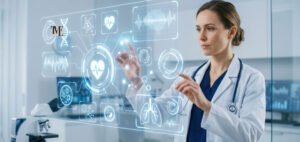


Worldwide healthcare systems are becoming increasingly dependent on one another in order to provide accurate, prompt, and reasonably priced medical care. One of the fundamental problems which confront modern medicine is diagnostic accuracy. When errors in diagnosis occur, the result could be the postponement of treatment, performance of unnecessary procedures, and the increase of healthcare-related expenses. Clinical decision-support (CDS) systems utilize advanced computing, data analytics, and artificial intelligence to present a new and effective way of dealing with such challenges, as these are becoming the leading-edge tools that revolutionize the medical field. By equipping healthcare professionals with on-demand insights and evidence-based recommendations, such systems not only serve as the contact point of medicine and the cutting-edge technology, but also enable professionals to make better diagnoses and thus, to improve the patients’ health outcomes in various clinical settings.
Data-Driven Diagnostic Accuracy
One of the major points clinical decision systems have is their power to bring together and make sense of different types of data. Today, healthcare gathers a lot of data in the form of electronic health records, laboratory results, imaging studies, genomic data, and even the data from wearable devices. CDSs process multidimensional data in real time, identifying patterns that may escape human observation. This capability enables accurate detection of disease markers and allows clinicians to identify early-stage, silent conditions that could become serious if not addressed promptly. Besides that, the data-driven strategy of CDSs is instrumental in the development of predictive analytics through which clinicians will be able to forecast disease progression and take the required measures in good time.
By analyzing local patient records as well as population-level data, these systems get the ability to map out disease progression, pointedly find the patients in the greatest danger, and suggest preventive measures. As an illustration, a CDS might notice that laboratory results have slight deviations that are indicative of diabetes or cardiovascular disease early stages. It is through these systems’ provision of timely alerts and evidence-based recommendations that clinicians are enabled to respond proactively and thus, patient complications are alleviated, and the final outcomes of patient care get improved.
Guiding Clinical Decisions
Medical decision support systems represent one of the most significant technologies to maintain and improve the quality of healthcare through the automation of processes. They are equipped with powerful processors and AI that find patterns that the human eye or brain cannot easily detect in massive databases and vast volumes of scientific and medical articles. Such resources might include diagnostic and therapeutic options as well as risk calculations grounded on the most recent medical research. They are especially helpful in cases that are complicated by the presence of multiple diseases or rare diseases, making it difficult to determine the diagnosis.
By furnishing the doctor with the most important insights which might have remained hidden, CDSs grant the doctor the autonomy to make decisions that are more qualified, less hesitant, and safer for the patient, to a better standard. Moreover, these tools are fundamental in normalizing healthcare delivery. Differences in the approach to diagnosis may cause the variation of the results of treatment, but CDSs help doctors to decide uniformly based on evidence-based guidelines. This uniformity is quite important, for example, in large networks of healthcare and community hospitals where the local shortage of specialists limits the access to their knowledge. By appropriating doctors with the correct leverage and prescribed protocols, CDSs liberate them from having to decide on the spot and make sure that patients get excellent care regardless of where they are they medical facilities.
Navigating Challenges Ahead
Despite their promise, clinical decision systems have to overcome a number of challenges before they can be widely used. A significant issue concerning them is data quality. If patient information is inaccurate or even incomplete, then the reliability of recommendations may be weakened which in turn may result in wrong diagnoses. Therefore, it is quite necessary to ensure interoperability between different electronic health record systems and at the same time keep up with data standards in order to take full advantage of CDSs. Moreover, clinicians should get sufficient instruction on how to understand and put into practice the insights provided by the system so that the use of technology does not make the clinical practice more complicated but rather helps it.
Clinical decision systems are poised for a highly promising future. Their capabilities are being elevated by the pioneering work in artificial intelligence, machine learning, and natural language processing. Next-generation systems could be equipped with on-the-spot patient monitoring, genomic sequencing, and even information about the social determinants of health to assist in understanding the patient’s needs comprehensively. Also, with the support of telemedicine and mobile health devices, CDSs will be able to access far-flung areas, thus making remote diagnostics, and personalized care possible. As these innovations progress, clinical decision systems could reshape healthcare to be more accurate in diagnoses, quicker in interventions, and overall better for patients.
Conclusion
Clinical decision support systems (CDSs) are on the verge of becoming a vital part of future medicine, not only solving the problem of diagnostic accuracy but also improving the whole patient care process. In fact, these systems are a perfect symbiosis of the human healthcare professional’s expertise and machine power. On the one hand, it is the power of big data analytics and artificial intelligence algorithms running on the latest available evidence-in most cases, extracted automatically from electronic healthcare records or medical literature. On the other hand, it is the healthcare professional who interprets and applies the AI results in the particular patient’s clinical context. But still, such a partnership forms a solid machine-learning pipeline for the most reliable and up-to-date clinical decision-making for a given scenario or individual. One of the major benefits that comes with the use of clinical decision systems is the reduction of errors in a big way. Such systems also ensure that the quality of health care is maintained at the same level throughout the medical institutions that a patient visits, and that health care centers shift their practice from reactive to proactive mode, thus clinical outcomes improve in all kinds of healthcare settings. Further, as the technology keeps on getting better, the CDSs will not be limited to the current scope only but will rather include new innovations like remote patient monitoring, personalized genomics, and social determinants of health in order to provide comprehensive and patient-centered care.